Slightly earlier than UK colleagues, I am preparing for the new school year which is about to begin at my international school and I have a new motto for the new year:
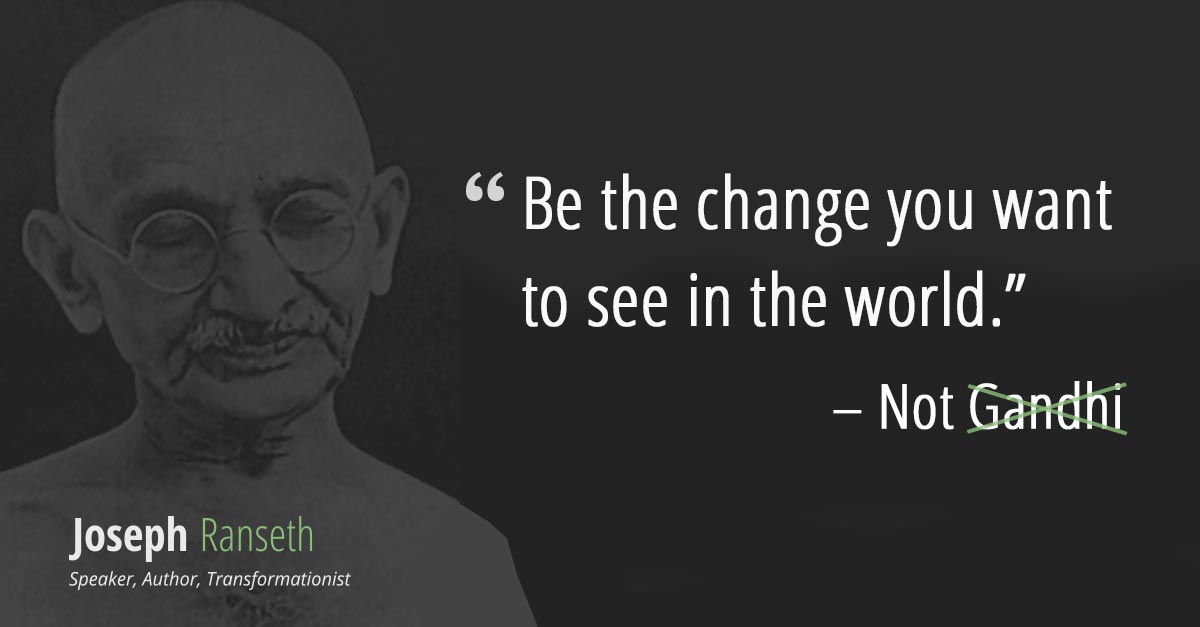
Ok, so Gandhi didn’t actually say those words. While still powerful advice, which I’m sure The Mahatma wouldn’t disagree with, you can find out more about his original (longer) quote from which this misattributed (and punchier) phrase comes from here. It is not simply about modelling behaviour or leading by example, but also about doing the hard work of confronting elements of our inner selves as we seek to be an example of positive change to others.
‘Experience is always shaped by our expectations’
Anyway, Gandhi didn’t say the words but it is still my motto. I think it is easy to dwell in negativity, pessimism (especially when masquerading as realism) and cynicism. I happen to have read a fair amount around that intersection between psychology and philosophy recently (not least from the wonderful website, The Marginalian, which I have mentioned before). Our expectations influence how we experience the world in a myriad of ways, from the attention we pay (or don’t) to the responses we make. Our brains constantly make predictions, decisions and judgements which govern our relationship with the real world. If we can try to consciously shift our expectations, we can nudge the dial on how we encounter the world (read Maria Popova’s take on Andy Clark’s work on this on The Marginalian).
“Since experience is always shaped by our own expectations, there is an opportunity to improve our lives by altering some of those expectations and the confidence with which they are held”
Andy Clark, The Experience Machine, quoted by Maria Popova on The Marginalian (link above).
If we can change how we encounter the world, this can help us to change the way we behave in the world (this is a feedback loop rather than a linear causation). By replacing negativity in some form, especially a subconscious negativity (a teachers’ e.g.: this INSET is bound to be bull***t because it always is) with a commitment to be positive, we can more easily behave in a more positive way, both helping ourselves and being a positive model for others.
If I can keep the focus on being positive and encourage positivity in others, then I am optimistic (see, it’s started already) that this will have a ripple effect. Then hopefully those ripples will echo back and keep the positivity from waning.
 Commonplace